
My first inkling that chainmail was once again having a moment was in Paris last year. I was on a work trip and it was Paris Fashion Week. It was the last night of my time in the city and I decided to head to Pigalle Country Club. A well known haunt for experimental music, dark lighting and unique style. It was here that I found Catholic Guilt. I was lucky to witness first hand their spellbinding show on the streets on Paris (image below). But more on that later.

Chainmail is armour.
It’s also a material. It’s metal woven into cloth.
The earliest surviving examples come from Celtic graves in Eastern Europe, 3rd century BC. But it has been around longer than that. The first recorded mention of something that sounds like chainmail dates back to 6BC, in the Avesta, the primary collection of sacred texts for Zoroastrianism. Originating from ancient Persia (modern-day Iran). While Herodotus, a Greek historian, documented that ancient Persians wore scale armour, the Avesta provides specific references to chainmail armour in its descriptions of combat gear.
Unlike the clothes of today’s fast fashion, chainmail is a slow process.
Each metal ring must be formed, closed, riveted or welded. One chainmail shirt contains tens of thousands of rings. In Japan, this is even more so the case; they weave a style of chainmail called Kusari, with rings so small that it looks and moves like fabric.
In India, alternate rows of solid and riveted rings in unique patterns catch the light like water. In Europe, different techniques were used again: 4 in 1, 6 in 1, King’s weave. These different techniques weave different stories and identities. In a way that the homogenised fast fashion of today can’t.
The metal rings also had to be made by hand which took more time still. Wire would be drawn through increasingly small holes a practice which took strength, skill and patience. A good chainmail shirt would take months. It would also never truly be finished, rather repaired, reused and passed down as a relic, carrying memory, connection and feeling of previous generations.
Women and chainmail
I wanted to look at the role of women in this business of chainmail. Women and weaving feel expected and obvious, throughout history, across borders, and this is largely the case. The domestic arts, the soft arts, the things you do at home with your hands.
But my instinct says that chainmail feels different. Even though it’s also a fabric, metal woven into cloth, and something that is worn, it has a different purpose: battle, protection, pride and war.
Which is where I suspect it gets more complicated. Undoubtedly, this will vary across cultures, places and time but I don’t have time to cover it all so i’m going to keep this quite general and brief but also suggest some places where you can find some interesting articles from people who have actually studied this and I hope you might be inspired to do some of your own research and if there’s anything you think I might enjoy please please share, i’m interested to learn more!
War is men’s work (Micheletti, Alberto J. C., Graeme D. Ruxton, and Andy Gardner, 2018).
Men’s stories, violence and armour.
And the bodies wearing chainmail on battlefields were almost always male bodies. The swords, the charging horses and castles under siege, all of it conjuring up images of men. These images are shown to us in so many forms, fairytales, stories and lessons at school that you might not even stop to ask why. But as I mentioned earlier, men were warriors, expected to fight, defend, dominate, prove their manhood, and protect their nation. Women and girls were the protected ones, the mothers at home, quietly keeping the cogs turning. It is this division of labour that gives birth to the idea of war as man.
This unrealistic, sexualised representation of Minerva, Roman Goddess of War (1598) is an interesting way to look at society’s relationship with women, battle and armour and you can read a lot more about it here: https://www.curationist.org/editorial-features/article/iron-women:-ancient-to-early-modern-women-in-armor

Chainmail was also a masculine craft. But there are examples of women, and it’s hard to know how many have been ignored and how many were doing the work in the background.
Records show Alice la Haubergere (The Mailmaker - direct translation), worked as an armourer in London in the early 14th century and was also known as one of the first female blacksmiths.
Agnes Hecche is another example, inheriting her father’s tools and work, as was typical of the women in this industry (Kirkland, 2015).
Interestingly, London armourers significantly influenced politics in ways beyond the battlefield. They did this through secret networks and guilds, which formed strong political identities and shaped responses to unrest.
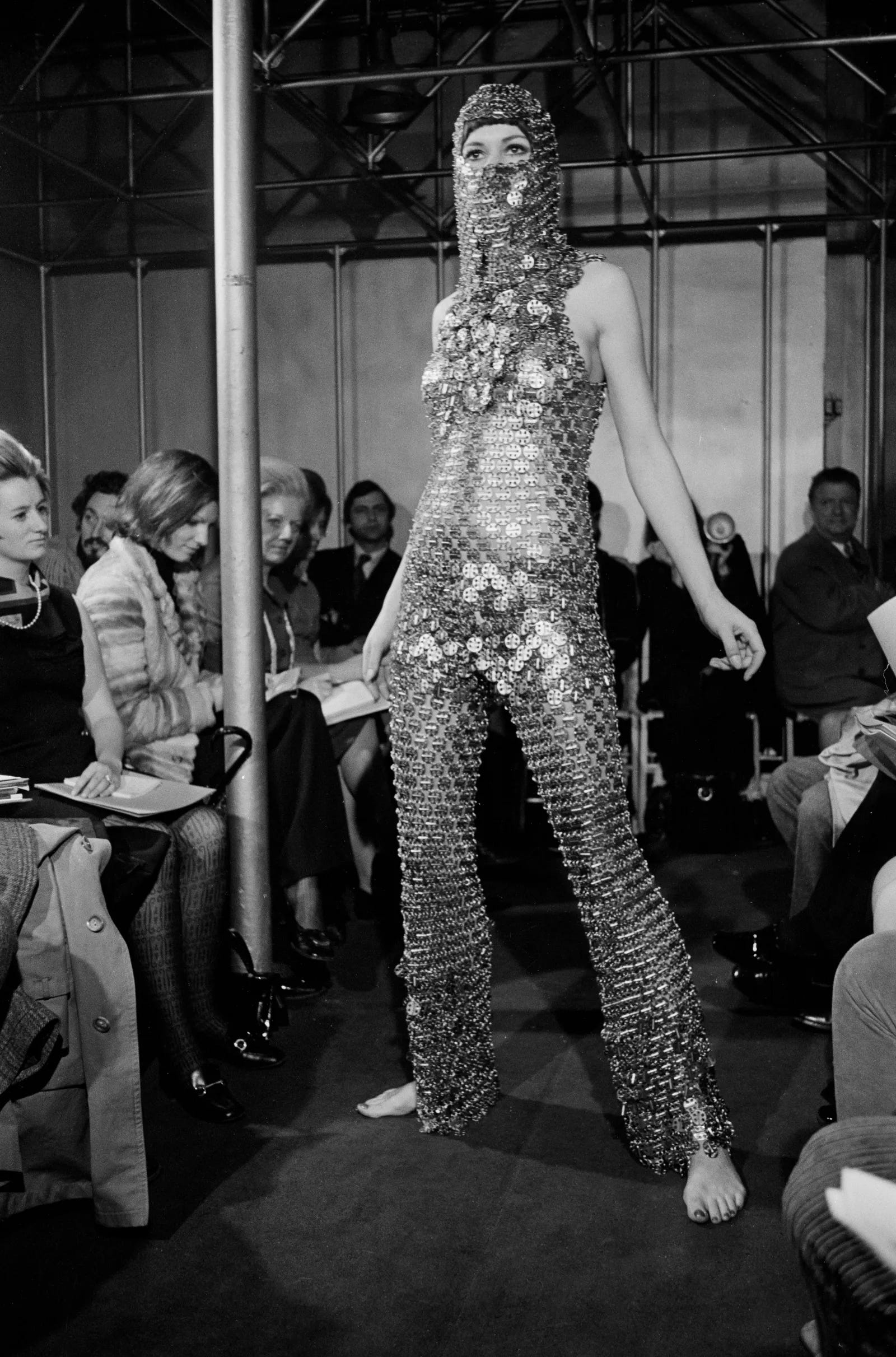
Fast forward, women are still sexualised, and ideas of beauty are still mostly unrealistic and fantastical. Until recently, if I thought of chainmail in a modern context, I would imagine chainmail bikinis, scantily clad runescape women of the woods, video games, and the semeny bedrooms of crusty boys. But let’s look at chainmail in fashion. First in the 60s, with Paco Rabanne:
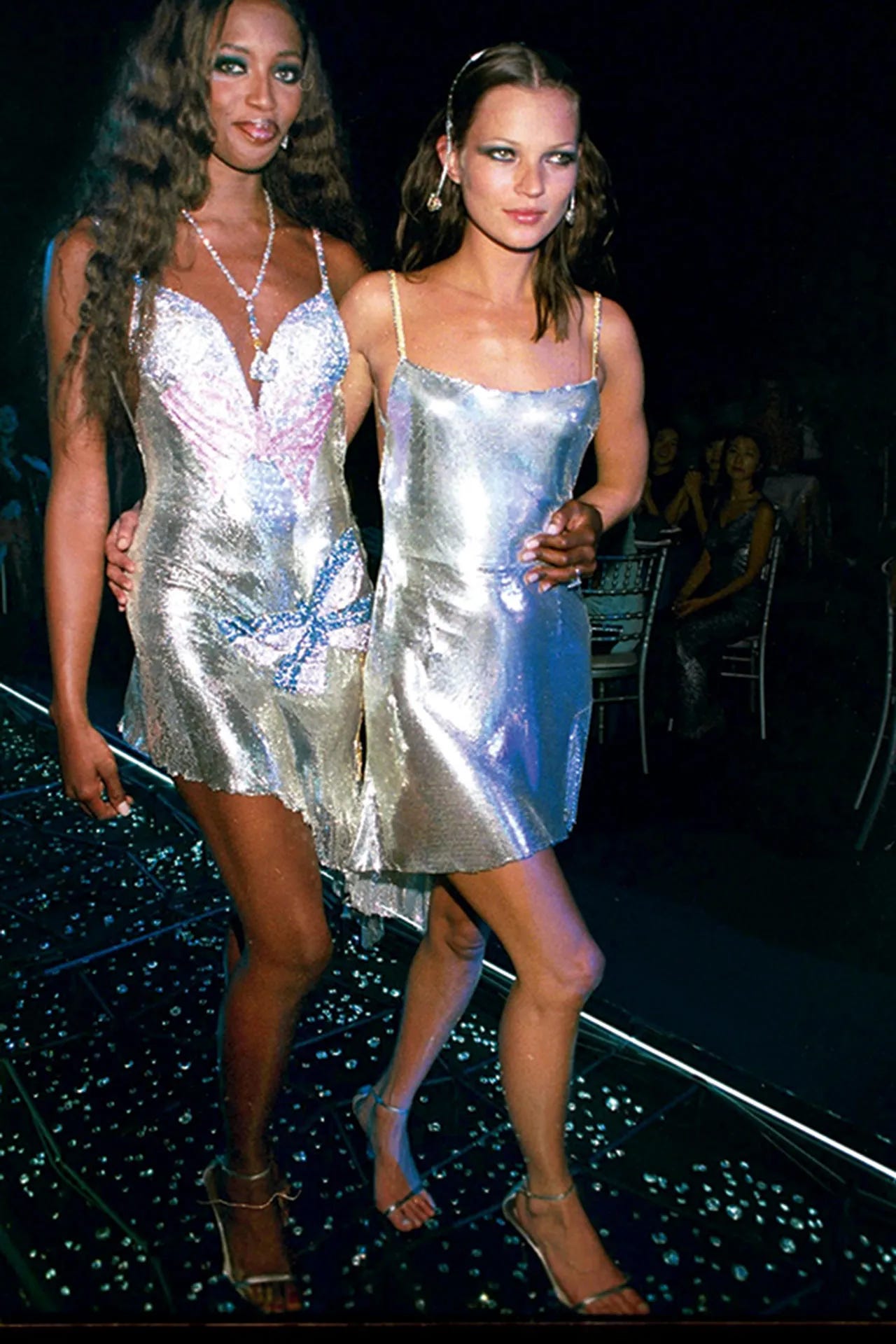
and reappearing in the 90s, notably with Gianni Versace, Kate and Naomi:
Most recently, appearing under the hashtag medievalcore and all over our feeds.
Catholic Guilt is paving the way with a fresh, modern take on this ancient method and giving it new life and airtime. Making fits that are hot and empowering and endorsed by none other than Julia Fox.
I also noticed a resurgence on the catwalk this AW. You only have to take a look at the recent Alexander McQueen show!
Our very own maillemaker, Sylvia, is also busy crafting unique pieces ready to be worn! Find her on our Instagram (@ritual.relic)
What other ancient methods and fabrics are being repurposed and designed today?